

The Sweet Spot for Most Players
I remember the first time I shot a marker with a real bolt system after years of playing with blowback guns. It was a buddy’s EMEK, and I honestly thought something was wrong with it because there was almost no kick. That’s the $200-300 range in a nutshell: you stop fighting your marker and start actually playing paintball.
If you’ve been running a Cronus or a Spyder for a while and you’re ready for a meaningful upgrade, this is the price bracket where the biggest jump in quality happens. Below $200, you’re mostly choosing between variations of the same spring blowback platform. Above $400, you’re paying for incremental improvements and electronic features that matter mostly in tournament play. But right here, between $200 and $300, is where you get the fundamentals dialed in: smooth bolt systems, quality construction, and markers that treat paint gently enough that you stop breaking balls in the breach.
Working with a tighter budget? Check out my best paintball guns under $200 picks.
The 5 Best Paintball Guns Under $300
#1: Planet Eclipse EMEK 100, Best Overall
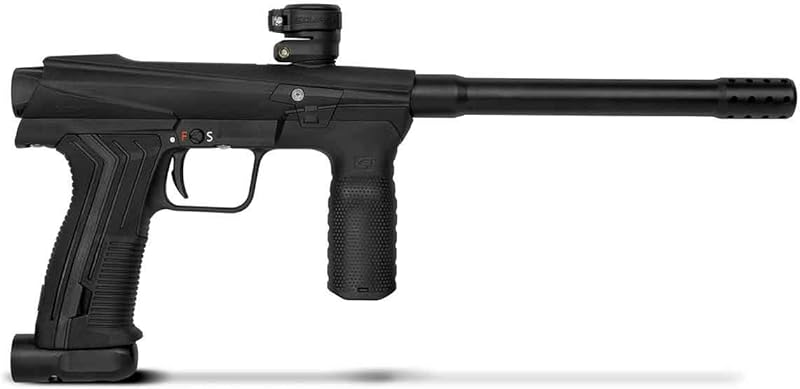
Planet Eclipse EMEK 100
The EMEK is, in my opinion, the single best value in paintball right now. At around $230, you’re getting Planet Eclipse’s Gamma Core drivetrain — the same bolt system technology found in their $1,000+ markers — in a mechanical package. The result is the smoothest-shooting mechanical marker on the market. I’m not exaggerating when I say the shot quality rivals markers that cost three times as much.
What makes the Gamma Core special is that it’s a spool valve design that operates entirely on air pressure, no springs in the firing cycle. That means virtually zero kick, incredibly gentle ball handling, and a consistency that spring blowbacks simply can’t match. I’ve run brittle tournament paint through an EMEK without a single break. Try that with a Cronus and you’ll be cleaning your barrel every other game.
Planet Eclipse also nailed the practical details. Tool-less disassembly means you can strip the bolt out in seconds for cleaning. The body is composite (not metal), which keeps the weight down without sacrificing durability. And the aftermarket support is massive: PAL-enabled hoppers, different trigger frames, cosmetic body kits. If you buy one marker in this price range, make it this one.
Pros:
- Gamma Core drivetrain delivers the smoothest mechanical shot available
- Tool-less bolt removal makes field maintenance dead simple
- Huge aftermarket ecosystem for customization and upgrades
Cons:
- Composite body feels less substantial than metal markers (though it’s genuinely durable)
- Trigger pull is a bit long and mushy out of the box; aftermarket triggers help
#2: Tippmann TiPX, Best Paintball Pistol
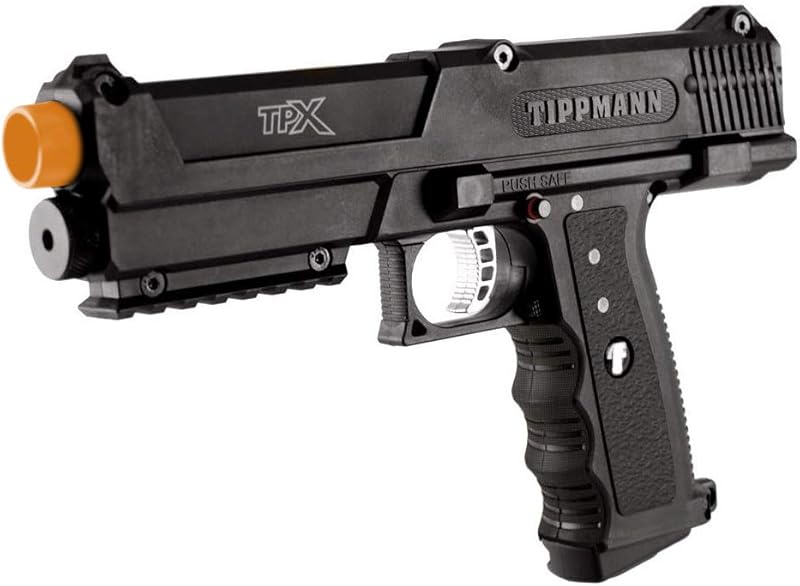
Tippmann TiPX
The TiPX is a completely different animal from everything else on this list, and that’s exactly why it’s here. At around $250, this is a magfed paintball pistol, and if you’re into scenario games, milsim events, or just want a sidearm that’s actually fun to run as a primary, the TiPX has a cult following for good reason. It’s compact, lightweight, and there’s something genuinely satisfying about playing an entire day with a pistol while everyone else is lugging around full-size markers.
Tippmann built the TiPX on their proven reliability platform, so it runs on 12-gram CO2 cartridges and feeds from 7-round magazines. Yes, that’s a huge ammo limitation compared to a hopper-fed marker, and that’s the point. The TiPX forces you to play smarter: pick your shots, use cover, and make every ball count. I’ve seen TiPX players absolutely dominate woodsball games because they move faster and think harder than guys spraying 200 rounds from behind a bunker.
It’s not for everyone. If you play speedball or prefer high-volume shooting, look elsewhere. But for scenario and woodsball players who want something unique and genuinely fun, the TiPX is hard to beat.
Pros:
- Compact pistol form factor is incredibly maneuverable in tight spaces
- Tippmann reliability in a magfed package
- Forces you to develop better positioning and shot selection
Cons:
- 7-round magazines mean constant reloading; carry plenty of mags
- 12-gram CO2 cartridges are an ongoing cost and get expensive over time
#3: Empire Axe 2.0 (Used), Best Used Electronic Option
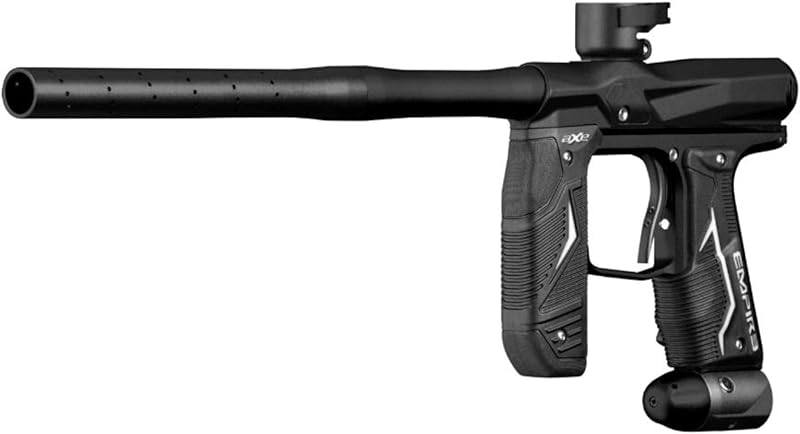
Empire Axe 2.0
Here’s the thing about the used market: a $500 marker from a few years ago is often a better buy than a new $300 marker. The Empire Axe 2.0 regularly shows up on BST (buy/sell/trade) forums and marketplace groups in the $250-300 range, and at that price it’s an absolute steal. This is a full electronic marker with multiple firing modes, an OLED display, and a smooth spool valve bolt system that was considered high-end when it launched.
The Axe 2.0 has a compact, lightweight body that makes it great for speedball, and the push-button bolt removal makes maintenance straightforward. It shoots well on HPA, and the overall build quality is excellent. Empire made a lot of these, which means parts and o-ring kits are easy to find and cheap.
The obvious caveat: you’re buying used, so inspect carefully. Check for bolt wear, o-ring condition, and board functionality before you hand over cash. Buying from reputable BST groups where sellers have feedback helps. But if you can find a clean Axe 2.0 in the $250-300 range, you’re getting electronic performance that new markers at this price can’t touch.
Pros:
- Electronic firing modes and performance well above what $300 buys new
- Compact and lightweight, great for speedball
- Readily available parts and strong community support
Cons:
- Buying used carries inherent risk; inspect thoroughly
- May need new o-rings or minor maintenance depending on condition
#4: Dye Rize CZR, Best New Electronic Under $300
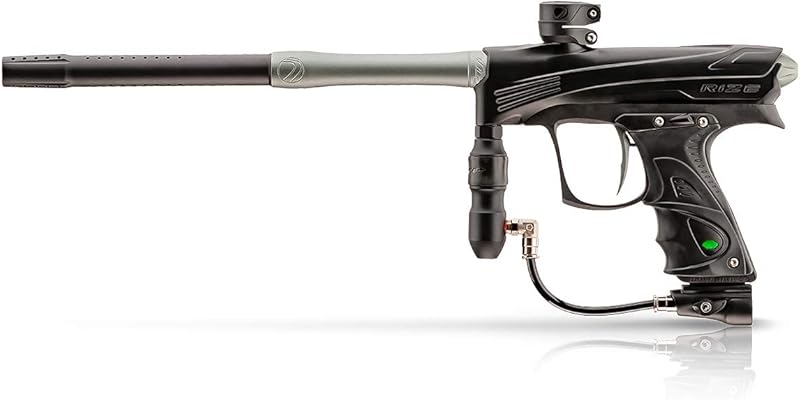
Dye Rize CZR
If you specifically want a new electronic marker under $300, the Dye Rize CZR is the best option available. At around $280, it gives you Dye’s Fuse bolt system, multiple firing modes, and that signature Dye quality that the brand is known for. It’s a spool valve design, so the shot is smooth and quiet compared to poppet valve markers, and the Fuse bolt is easy to maintain with tool-less removal.
The CZR is essentially a stripped-down version of Dye’s higher-end markers, which means it benefits from trickle-down engineering. The barrel is decent, the grip frame is comfortable, and the overall package is well thought out. It runs on HPA and has the kind of shot quality that lets you know you’re shooting something a step above budget territory.
I will say this though: for the money, the EMEK gives you better shot quality in a mechanical package. The CZR makes sense if you specifically need electronic firing modes for speedball or your league requires a certain rate of fire. For general recreational play, the EMEK at $50 less is the smarter buy. But if electronic is what you’re after, the CZR earns its spot on this list.
Pros:
- Legitimate electronic marker from a top-tier brand at under $300
- Fuse bolt system is smooth, quiet, and easy to maintain
- Multiple firing modes for competitive play
Cons:
- At this price, the mechanical EMEK arguably outperforms it in raw shot quality
- Battery-dependent; keep spares on hand
#5: Planet Eclipse ETHA 2 (Used), Best Used Value
Planet Eclipse ETHA 2
The ETHA 2 is basically an electronic EMEK. It runs the same Gamma Core drivetrain but adds electronic firing modes, an OLED board, and the ability to ramp and burst fire. New, the ETHA 2 runs around $400-450, which puts it out of range for this list. But used ETHA 2s regularly show up in the $250-300 range, and at that price they might be the best deal in paintball.
Think about what you’re getting: Gamma Core smoothness, electronic versatility, Planet Eclipse build quality, and a marker that’s been tournament-proven at every level from local leagues to national events. The ETHA 2 is the marker that a lot of players buy and never feel the need to upgrade from. It does everything well, and the Gamma Core is so reliable that even a used one with thousands of shots through it will likely function perfectly with a fresh set of o-rings.
Same advice as the Axe 2.0: buy from reputable sellers, inspect the marker, and check that the board and solenoid work properly. But a clean ETHA 2 in the $250-300 range is genuinely one of the best purchases you can make in paintball at any price point.
Pros:
- Gamma Core drivetrain in an electronic package; best of both worlds
- Planet Eclipse reliability means even used markers tend to be in great shape
- Tournament-capable performance at a fraction of its new price
Cons:
- Requires buying used to hit the sub-$300 price point
- Cosmetic wear is common on used markers, though it doesn’t affect performance
Why $200-300 Is the Sweet Spot
I’ve played with markers at every price point from $50 rental guns to $1,500+ tournament setups, and the $200-300 range is where I tell most people to land. Here’s why:
Below $200, you’re stuck with spring blowback bolt systems. They work, but they kick, they break paint, and every shot reminds you that you’re shooting a budget marker. The markers are functional, but they’re not enjoyable to shoot in the way that a higher-end marker is.
Above $400, you’re paying for electronic boards, OLED screens, tool-less everything, and bragging rights. Those are nice features, but the actual shooting experience? The jump from a $300 marker to a $600 marker is nowhere near as dramatic as the jump from $150 to $300. Diminishing returns hit hard above this range.
At $200-300, you get engineered bolt systems that virtually eliminate kick and ball breaks, build quality that will last for years, and markers from brands (Planet Eclipse, Dye, Empire) that actually support their products with parts and service. This is where the value peaks.
What Changes at This Price Point
If you’re coming from a sub-$200 marker, here’s what you’ll notice immediately:
Bolt systems get real. This is the biggest difference. Instead of a spring slamming a bolt forward to push and fire a ball (blowback), you get engineered spool valve or poppet valve designs that use air pressure to cycle smoothly. The Gamma Core in the EMEK is the prime example. Less kick means more accuracy, less fatigue, and way fewer broken balls.
Build quality goes up. Markers at this price are designed to be maintained and serviced, not replaced. Tool-less bolt removal, quality o-ring seals, properly machined internals. These things are built to last thousands of games, not just a season.
Maintenance gets easier. This sounds counterintuitive, but higher-quality markers are often simpler to maintain than cheap ones. Tool-less disassembly, better-documented maintenance procedures, and readily available parts kits mean less time wrenching and more time playing.
Paint handling improves dramatically. Gentle bolt systems mean you can run higher-quality paint without breaking it in the breach. Better paint means better accuracy and more consistent performance. It’s a compound improvement that makes everything about your game better.
Looking for the full range of options? Check out our best paintball guns roundup for markers at every price point.